Thursday, June 16, 2011

Horizontal Alpinism


French poppies
"The idea of a circuit was devised by Fred Bernick as a sort of horizontal alpinism, a substitute for a mountaineering route..." -Fontainebleau Climbs by Jo and Francoise Montchausse and Jacky Godoffe
Bouldering was my climbing childhood. My friends and I must have done the nine-hour round trip drive from the University of New Hampshire to the Shawangunks to go bouldering at least a half dozen times before I ever even thought of roping up there. I even traveled to Nepal's Khumbu Valley in 2004 to go bouldering, just bouldering, in the shadows of the Himalaya's greatest peaks. It was the most accessible (read: cheapest) way into climbing for me as a college student, plus, a childhood of gymnastics and horseback riding/stall cleaning developed my shoulders for the powerful movement it requires.

So I went to the bouldering mecca of Fontainebleau to fulfill a dream that seeded itself more than a decade ago. But the times have certainly changed since then. This trip, I stopped in Font on my way to Chamonix to climb mountains.


All I'd heard about the magical forest of Fontainbleau is true: it really does have more climbable boulders strewn in a 1,000 kilometer area than I have ever seen anywhere. There really are four generations of French families out climbing together on any given day of the week, and the oldest of them are wearing the shortest shorts and climbing the hardest, scariest problems.
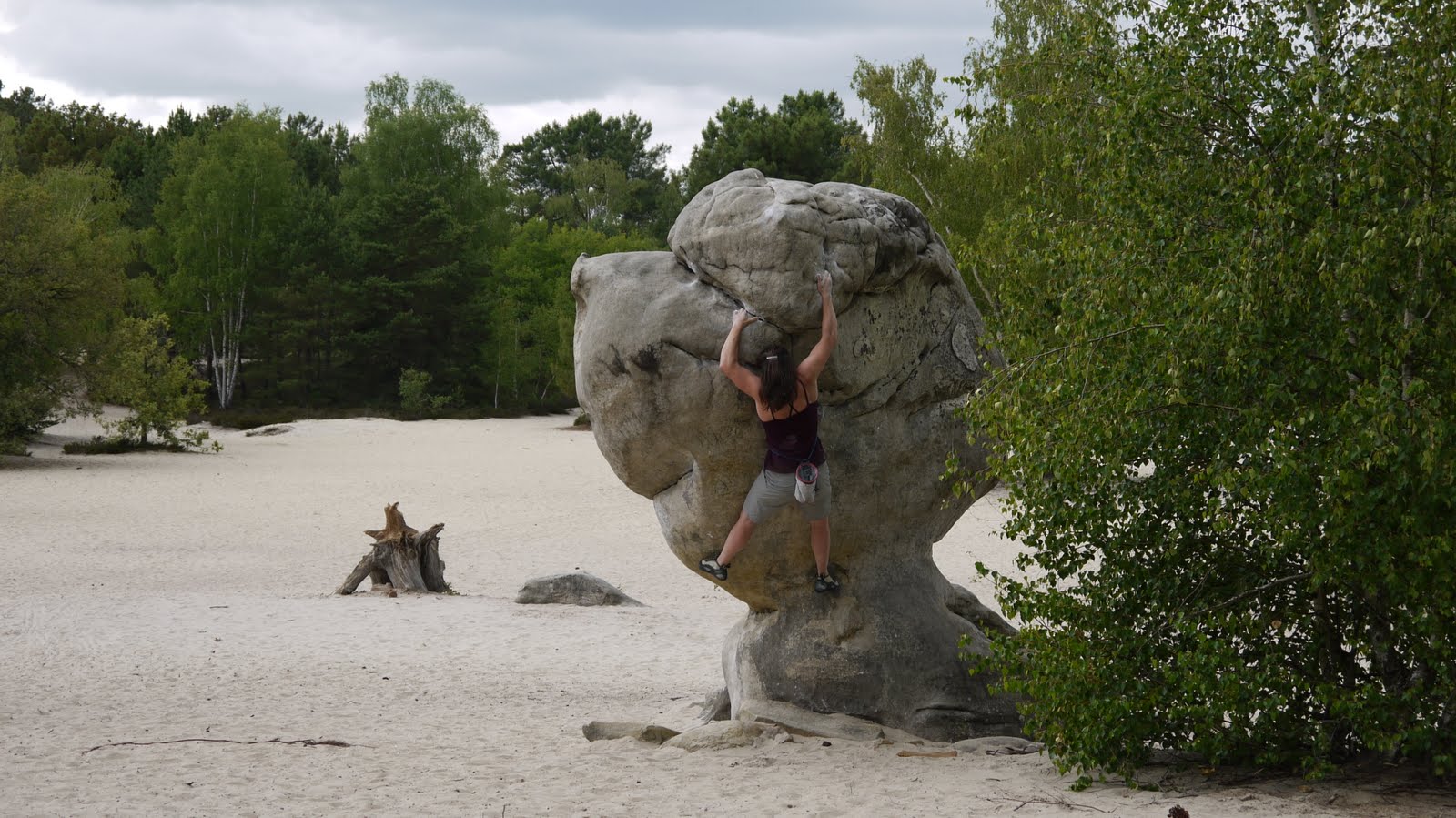

'Cul De Chien' (Head of the Dog - can you see it?)

I was a good alpinista and spent the first two of the three days I had there climbing Fontainebleau's classic moderate bouldering circuits, training for a mountain climbing summer just as the area was originally developed for, and just as French alpinists have been doing for more than seventy years. (Another curious thing about Font is those circuits. The boulders are painted with colored numbers and arrows to create hundreds of circuits for climbing. There are circuits for children, circuits for beginners to experts, circuits for crimping or for crack climbing, and everything in between. It is such the norm that routes that are not in a circuit are literally called 'off circuit'!)

But my boulderer instincts got the best of me by day three. I could not take my eyes off of the incredible lines of the harder routes that were 'off of our circuit'. We were having fun on our easy climbs, but the real boulderers, who were pushing themselves at their absolute physical and technical limits, were having a different kind of fun that I remembered very well. So with a few hours left in the day I finally gave in, stacked my crash pad with many others under the classic 'La Joker', and sat down to change my climbing shoes from the oversized pair that I needed to break in for mountain climbing this summer into more appropriate 'racing slippers'. I threw myself at it until I'd lost any reserves of fingertip skin and arm and core strength I had left.

Changing those shoes was like changing personalities and it felt great to get a glimpse of that self that I came to climbing from. Indeed, I aim to reacquaint myself more fully with that side soon. But first, I have some mountains to climb.

The scene in Fontainebleau

Stay tuned for more from France! Huge thanks to Jack and Catherine and all of our new friends from The Forest.

Monday, May 16, 2011

The Eight-Mile Loop

Drizzle splashed on my cheeks and eyelashes as I jogged along the far side of an eight-mile loop behind our cabin in Madison, New Hampshire. A quickly thickening canopy of deciduous forest grew over the Class VI dirt road. I smiled, realizing that I felt no pain. That, and because I’d caught a glimpse of a shiny wet leather couch off to the side. It belonged there, an erratic, as if a glacier had played a practical joke.

My run-ins with chronic pain began in 2004, with an ankle injury from bouldering that I avoided proper treatment for. Nearly two years after the accident I finally had surgery, followed by a long recovery, and then promptly re-injured the same ankle when a hold broke while sport climbing in 2008. As I finally regained health in 2010, I came down with severe elbow tendonitis for 13 months (read my post from the throes of it here and if you are suffering from it go here for the guaranteed cure).

Now, in May 2011, encouraged by the security (and thus freedom) of marriage and the luxury of intentional underemployment, I am feeling especially lucky to have, and be able to take advantage of, full body health.

I know my ankle will not always be this way. My orthopedic surgeon, as he customized a pair of orthotics to help preserve the newly grown bone and what little cartilage is left in my right ankle, warned that I should carefully choose my running miles and long walks with heavy backpacks. He said his fix could last 1 year or 10 years, depending on how I treated it, and that I should keep my fingers crossed for better full ankle replacement technology in the meantime. So every mile I get to run without pain is a blessing, and every approach or descent with a 50+ pound pack is intentionally chosen.

I was on the 8-mile loop to prepare my body for the coming ‘Indian Summer’. I’ll meet my friends Emilie Drinkwater and Kirsten Kremer in Delhi, India, on July 3 and we’ll head north to the Eastern Indian Karakoram. Our main objective is an unnamed unclimbed 6,000 meter rock peak in the Saser Muztagh. Our secondary objective is to be nuisances to our trip leader Mark Richey (who will attempt a nearby peak with Steve Swenson and my husband Freddie), who says he hasn’t shared an expedition with women in more than 20 years because they ‘are trouble’.

My windshirt, now soaked with rain, stuck to my arms as I turned up Glines Hill Road, our local version of Heartbreak Hill, with a mile straight of steep climbing. Don’t Stop Believing by Journey came up in the workout mix, as if on cue. I’d never wandered beyond a 5-mile loop in our neighborhood, and even on this cruelly steep homestretch, I felt light, energized and thankful for health’s simple gift of an allowance to push one’s limits.

We are thrilled and honored to have received a Polartec Challenge Grant for the upcoming summer of fun and adventure. Thanks also to Mountain Hardwear, Petzl, Sterling Rope Company and La Sportiva for helping to make this dream a reality.

Tuesday, April 19, 2011

Greg Mortenson Must Step Down

Greg Mortenson must step down.


It is hard to say, but since none of my colleagues in the nonprofit industry have said it yet, I must take a stand for nonprofit business best practice.


To start with, here is a quick primer on the key legal responsibilities of nonprofit boards of directors (Boardsource, Legal Responsibilities of Nonprofit Boards):

Duty of Care, or, "care that an ordinarily prudent person would exercise in a like position and under similar circumstances." A board member must exercise reasonable care when he or she makes a decision as a steward of the organization.

Duty of Loyalty is shown when a board member gives undivided allegiance when making decisions affecting the organization. “This means that a board member can never use information obtained as a member for personal gain, but must act in the best interests of the organization.”

Duty of Obedience requires board members to be faithful to the organization's mission and central goals. “A basis for this rule lies in the public's trust that the organization will manage donated funds to fulfill the organization's mission.”

Three facts, which can be drawn from the Central Asia Institute (CAI) website alone, bring all three of the above duties into question:


1. Greg is one of only three members of the CAI Board of Directors. The legal minimum is often five and sometimes (apparently in Montana where CAI was formed) three. By comparison, the average size of a nonprofit board is 16 members, and organizations with budgets of $10 million or greater (CAI's income was at least that every year since 2008) have an average size of 18 members (2010 Governance Index Survey). Anyone who has worked with a nonprofit organization of any size knows that there are hundreds of questions to consider annually with the three above duties in mind - so a reasonably sized board ensures due diligence, simply by way of managing the workload.


2. Greg is a board member and the organization’s highest paid executive. This is extremely rare in the nonprofit industry for two reasons: The executive has a long list of responsibilities already as the organization’s operational manager without also adding on board member work, and, the separation of board and staff simplifies board decision making because of obvious and constant considerations around conflict of interest when a paid staff member is voting. For example, one major board responsibility is to select and evaluate the executive director. So in the case of CAI, only two other board members are able to evaluate Greg’s performance and make salary decisions (assuming he takes himself out of those votes because of a conflict of interest/duty of loyalty).


3. The Montana Nonprofit Association, where CAI was founded, published as part of its nonprofit principles and practices that “a nonprofit with annual total revenues in excess of $500,000 should subject its financial reports to an annual audit by a certified public accountant.” The more regularly accepted best practice is to undergo an annual external audit once the budget hits $1 million. CAI has had annual revenues in excess of $500,000 since 2003, with only one external audit, ever. This does not follow duty of obedience, and shows a clear lack of transparency and accountability to thousands of donors.


Greg, as chief executive AND board member, IS responsible for these issues. There is no one to pass the blame to. I don’t care how shy he is or how quickly the organization grew. By agreeing to be executive director and board member, he took on the very highest duty of care.


These concerns, coupled with the fact that the organization was so dysfunctional as to not have, at the very least, a PR professional instantly on the ground seeking out 60 Minutes the moment they learned of the investigation, make me very worried about the overall health of CAI.


As a donor to CAI, I got a form email from Greg on Sunday night in which he answered none of the questions raised by the 60 Minutes story or Jon Krakauer, or even simply about the above concerns over generally accepted nonprofit best practices. It is clear to me he is unfit to run the organization, no matter how well intended he is, not matter how much good he has done in the past.


What he has done right is create a strong, timely mission that CAN survive this huge bump in the road – IF he and the other two board members have the sense of duty to step down right now.

Wednesday, March 16, 2011

The Ides of March


March 15: The days are longer and the sun is stronger. The big question this time of year on the sunny days is whether to go rock climbing or into the mountains. Yesterday, the snow slogging won. I skinned up to the Hermit Lake Shelters to pick up Sarah, who is cooking for a film crew this week, and we headed over to Huntington Ravine to climb Odell's gully. It was a bit hairy with some weird wind slab snow in places, but nonetheless a fun day, as they always seem to be with her.


Gear for a splitter spring day on Mt Washington:
Mountain Hardwear Chockstone Jacket
Polartec Test Jacket
La Sportiva Spantik Boot
Petzl Selena Harness
Sterling Marathon Half Rope

Wednesday, February 23, 2011

New Tricks


My friend Mark has been on a major climbing expedition for 18 of the past 20 summers.

He and his savvy wife Teresa also own a hugely successful and highly respected custom woodworking business in Massachusetts that they built from scratch. The high value they place on travel means that the business has always been able to run with or without them (One of their great adventures was pulling their teenage daughter out of school for a year to tour Teresa’s home country of Peru in a Range Rover). I dig their style; living ‘outside the box’, always accepting of risk, and having a ton of fun along the way, and I consider them among my strongest role models.

I will be lucky enough to share base camp with Mark this summer in India, and my husband Freddie will be one of his climbing partners, so we’ve all been training together when possible.

Freddie and Mark spent the night in Huntington Ravine on Mount Washington in January to test some gear, and Freddie suggested they use alpine touring skis for the approach and descent instead of hiking (an alpine touring set up has special bindings that allow one to wear mountaineering boots or ski boots, and can be set to hinge on the toe like a cross country ski for climbing).

“You really think it will be faster to ski?” Mark asked Freddie.

Freddie said he should have known that Mark hadn’t been skiing much when he asked that question. Their descent did take about as long as hiking would have, as Mark was slow and took several falls.

This past weekend the three of us went to Mount Washington again and decided to again use touring skis. Mark, who’d spent 20+ years religiously hiking the Tuckerman trail to approach winter climbs on Mount Washington to train for his expeditions, was fully converted. He’d only used skis since that day with Freddie.

We had a blast climbing Huntington Ravine and on to the summit in whiteout conditions, but when we got back down to our skis it was my turn to be nervous about skiing in mountaineering boots. I’d only recently switched to an alpine touring set up from telemark, and was still feeling claustrophobic about having my heels locked down. Picturing a torn ACL or worse, I told them I was content to leave my skins on and glide slowly down, or even carry my skis if necessary.

“You really should just try it,” urged Mark. “It is a great opportunity since you have a light pack and the snow is in good condition…and it will be fun!” he said over his shoulder as he slid off.

‘Great opportunity’, I grumbled to myself.

I realized there were two ways to think of it: 1) I’d had a great day and could leave it on a good note or 2) Why not allow the possibility for a great day to end even better, and learn something along the way?

I peeled the skins off, locked the heels down and went for it, and that day Mark passed the ‘most recent convert’ status on to me. He also proved, once again, how to be a role model.


Photos by Freddie Wilkinson

Gear for climbing Mount Washington:

Saturday, January 29, 2011

Newfoundland Adventure

It must be dark, cold January in New Hampshire, as I’ve found myself nostalgically recalling stories from a rock climbing trip to Newfoundland with Sarah Garlick and Kirsten Kremer in 2009.

The adventure started at friends Alycia and Timmy’s wedding on Cape Cod in late August. We picked up Kremer at Boston Logan airport the next morning, proceeded to New Hampshire to pack Sarah’s Previa minivan and continued on the 18 hour journey to ‘the island’. We had only a few weeks to play before Sarah’s wedding back in New Hampshire.


Once in Francois (pronounced France-way by locals, and only accessible by boat), we were essentially adopted by ‘the Georges’, George Durnford and George Fudge, and their families, who fed us food and information, gave us a ride to ‘Camp Paradise’ on the trusty Royal Oak, a beautiful cod fishing boat, and loaned us Rojito the red dingy and a few mismatched paddles to get around from our beach camp to various cliffs in Shaleur Bay.
The hospitality didn’t end there. They checked in on us regularly, offering a towline between climbs and camp on several occasions. George even gave us a lift across the bay one afternoon to drink sweet wine and munch freshly steamed mussels as the sun went down with a dozen other Francois-ans.


The day they came to pick us up to head home, there was a huge rack of antlers mounted on the front of Royal Oak. Moose hunting season had begun that day, so they’d spent the previous night camped out in the next bay over, succeeded in a kill at dawn, dragged it out, butchered it and loaded it up all before even picking us up that morning. We drank rum and cokes in celebration of our dual successes, and the Georges’ were received like heroes when they pulled into the Francois harbor with a boat full of women and meat.


The climbing? It was pretty good too. Check out the little video to see for yourself.

(Above photos by Kirsten, Sarah and me.)

Newfoundland: Wedding Sandwich Climbing Trip from janet bergman on Vimeo.

Some gear we used:

Mountain Hardwear Trango Tent

Mountain Hardwear Women’s Ultra Lamina Sleeping Bag

La Sportiva Women’s Katana

Sterling Marathon Ropes

Petzl Selena Harness

Sea to Summit dry bags and stuff sacks

Thanks to Joe Terrevechia and Karin Bates for photos and information that made the trip possible and to Jim Surette for being a patient husband-to-be while the girls went to play!

Friday, December 3, 2010

Baby Waiting, Lebron Hating and Climbing Training

I have been here in my old stomping grounds of Chagrin Falls, Ohio the past 10 days, waiting for my little sister to deliver her first bundle of joy into the world. This is the longest I have spent here in recent years, so it has been fun to settle in for a spell.

Our extended family put on an ‘Original Thanksgiving’ last week, which we do every five or so years. We dressed up like pilgrims and Indians and cooked a feast with only ingredients, implements and cooking methods from the 1600's. My New England Indian, Freddie, kept sneaking inside to watch the Patriots game, but this was his second time participating in the ‘OG TG’ and he is an incredibly good sport about my family’s shenanigans.

I can’t help but get caught up in Cleveland sports each time I am here and this week has been no different. I went downtown with my dad to see the Cavs-Celtics game on Tuesday, and with my mom to the local bar to see the Cavs battle Cleveland's most recent heart breaker, Lebron James, and the Heat on Thursday. What would we do without the villains and heroes of pro sports?

So between the pheasant stew, boiled lobsters, baby-anticipating and Lebron-hating, I have been trying to stay active for the pending ice climbing season in New Hampshire.

Lucky for me a gym ($5 per drop-in visit!) and a yoga studio popped up across the street from my mom’s house in the past year, as did a protected park with a 3-mile loop trail through woods and fields.

I have never in my life been on a regular gym workout program, nor do I claim to be at a level of fitness that would make it acceptable for me to tell others how to work out. But I thought I would share a few exercises I’ve been using to target areas in which I am typically weak at the start of the winter season.

My current workout recipe is to start with 45-60 minutes of cardio, and then cycle through moderate reps of 10 or so different exercises focusing on pulling, pushing, abs and legs for 30-45 minutes. I am still dealing with elbow tendonitis, so I work in a lot of arm stretching too.

A few exercises I’ve found for winter-specific strength building:

  • Abs (with footwork and figure-fouring in mind): Leg raises on the pull up bar. I try to bring my feet as least 12 inches above my head, which requires curling the whole back instead of just the lower abs. I can only do about 10 of these at a time. Too easy? Go slower!
  • Pulling (with lateral mixed climbing moves in mind): On a pull up assist machine, set up 80%+ of body weight assistance. Start with arms at the widest possible stance and alternate pulling up and lowering with one arm only (leaving the other hand in place but just loosening grip so it is not engaged). I always feel like I am going to pull my shoulder out of socket at the beginning of winter when making lateral dry tooling moves, so this feels like it is helping to strengthen that wide pulling action.
  • Legs: Jumping telemark turns, jump roping and box jumps. All pretty self explanatory, I do 20-30 reps of each between the upper body exercises to build strength and keep the heart rate up.
  • Stretches: The best stretch I have found for medial elbow tendonitis was suggested by my friend Jay Conway. Stretch the arm straight out to a wall, hand flat, thumb up and turn away until feeling a stretch. To intensify it, move your ear towards the opposite shoulder. When I first started to do this I could barely move my head. It feels incredible. Another stretch: Hold a resistance band straight in front of the shoulders, standing up. Move arms all the way outward at shoulder height, keeping them straight. I feel a sort of stretch/strengthening in the sub-scapular muscles with this one, an area I have trouble targeting. I know a few friends who keep a band in their climbing packs and do this exercise before and after climbing, always. I am trying to be like them, if only I didn’t get too excited about about climbing and forget every time I go out.

Workout gear:

Mountain Hardwear super power tights

Mountain Hardwear wicked lite tee

La Sportiva fireblades

Workout tunes: Los Sugar Kings (listen for the clave!)

OK, enough working out, we are ready for that baby anytime, Bobbi!

(Images from the uber classic Red Pillar of Mermoz, Argentine Patagonia, with Kirsten Kremer in 2008)